What problem are you solving by selling?
Selling rarely fixes “I’m tired” by itself. It fixes a specific pressure: the company has become your personal balance sheet, and one bad quarter, one key employee leaving, or one customer pausing spend can hit both income and net worth at the same time. If you’re carrying debt, signing personal guarantees, or fronting payroll out of a line of credit, that risk isn’t theoretical.
The clean reason to sell is to trade an illiquid asset for choices. Cash at close (even if it’s less than the dream number) can pay off guarantees, diversify, and stop the cycle of reinvesting every dollar back into growth just to keep the machine steady. Waiting can work too, but it usually means another 12–24 months of execution with no slipups, plus the cost of running a process and keeping it quiet.
When owners can’t name the exact problem they’re buying down—concentration, burnout, capital needs, family timing, or exposure—they drift into deals that leave them working just as hard, only with less control.
When is the sale timing actually in your favor?

That drift usually shows up as “let’s wait until next year,” without pricing what “next year” costs. Timing is in your favor when the business is already proving its story—steady margins, no heroic founder hours, and a backlog or renewal cycle that makes the next two quarters feel predictable. Buyers don’t pay extra for a plan; they pay for a pattern.
It’s also in your favor when you can run a sale process without breaking the business. If closing a deal would steal your best operator for three months, or you can’t keep numbers clean while answering diligence requests, the process itself can create the dip that lowers the offer.
Waiting can be smart when a fix is truly close—one customer concentration coming down, a pricing change landing, a key hire already signed. But if the “fix” depends on perfect execution for 12–18 months, you’re betting your payout on no surprises, in a period when surprises are normal.
How buyers will value you in practice
In a real process, the headline multiple is the last thing that gets agreed. Buyers start by deciding what “earnings” they trust: EBITDA, sometimes SDE, and then they normalize it by stripping out owner perks, one-time legal bills, and “temporary” contractor costs that suddenly look permanent. If your margin depends on you doing sales at night, they discount that too, because they’ll have to replace it.
Then they price the risk around those earnings. Customer concentration, lumpy projects, weak retention, and thin management all pull the multiple down or push value into an earn-out. The same $2M EBITDA can trade very differently if one customer is 30% of revenue or if renewals are already signed for the next two quarters.
Finally, working capital becomes the quiet haircut. A working-capital peg, deferred revenue, aged AR, or inventory that won’t move can shift six figures at close, even when the purchase price “stays the same.”
Clean numbers versus clean operations under scrutiny
Once the model makes sense on paper, diligence shifts from “is the EBITDA real?” to “will it stay real after you step back?” A clean P&L helps, but it won’t cover operational gaps that show up in customer files, job costing, renewal terms, or how exceptions get handled when something breaks.
The friction is speed. Buyers will ask for support schedules in days, not weeks: AR aging tied to the GL, revenue recognition tied to contracts, backlog logic that matches delivery capacity, and proof that discounts and credits aren’t quietly propping up retention. If it takes three people and a weekend to answer basic questions, they assume the business runs the same way.
This is where “we can fix it after LOI” gets expensive. The fix competes with running the business, and any miss during the process—late billing, margin slippage, a key ops person quitting—turns into a purchase-price adjustment, a bigger holdback, or a longer earn-out just to bridge the uncertainty.
Deal structures that look safe but aren’t
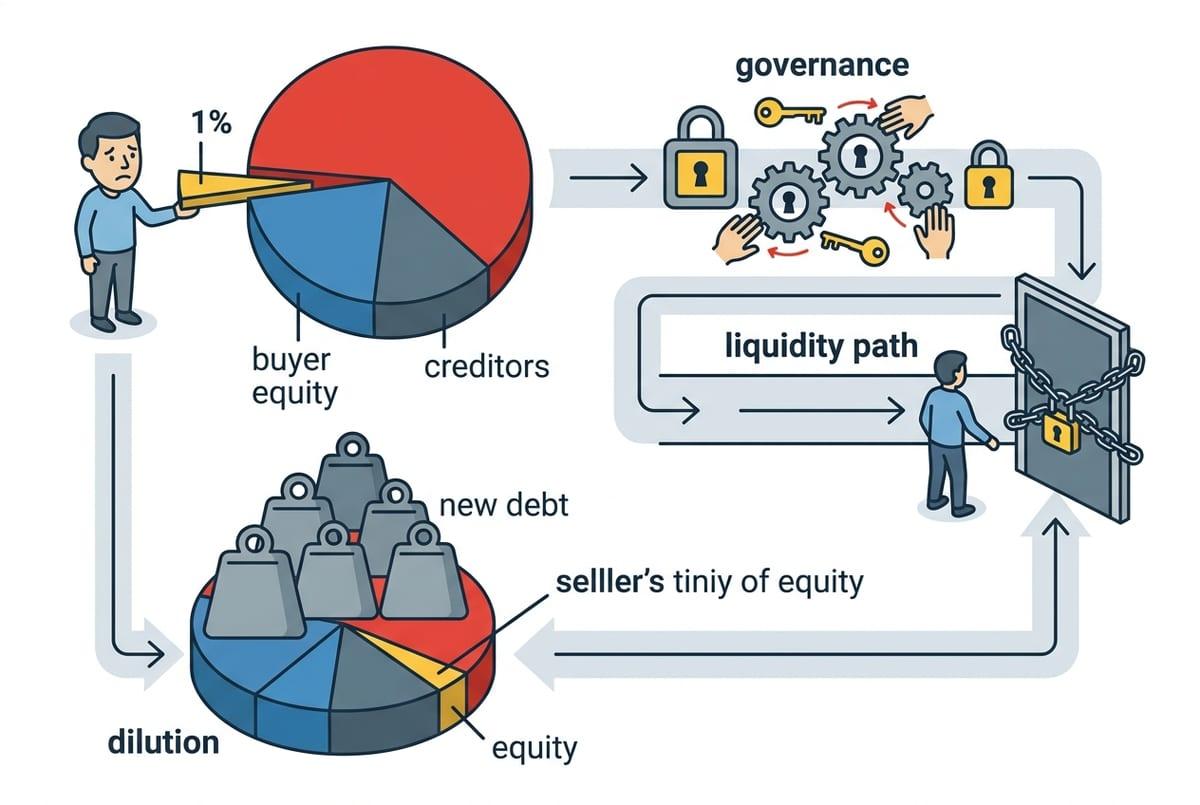
After diligence, the paper can still make an offer feel “safe” because the top-line price is big and the lawyer says the terms are market. The risk is that the money is sitting in places you don’t control: an earn-out tied to targets you can’t hit without spending, a working-capital peg that assumes “normal” when your business is seasonal, or a purchase-price adjustment clause that turns a bad month of collections into a six-figure true-up.
Seller notes and “friendly” holdbacks are similar. They look like interest income until the buyer misses covenants or argues a breach of reps and warranties; then you’re negotiating under their cash-flow pressure, not yours. Even a rollover can be a trap if your minority stake has no real governance, no liquidity path, and gets diluted by future debt you didn’t approve.
The safer question isn’t “is this common?” It’s “what has to go right, for how long, and who gets to decide?” If the answer is “two strong quarters after close” and you’re still signing as an employee, it’s not a clean exit—just a delayed price negotiation.
Your people, your customers, and the transition hit
The transition hit shows up before closing. Once a deal rumor leaks, your best people start doing private math: will their role shrink, will comp change, will the new owner cut costs. If you wait until LOI to talk about retention, you’re already late. Buyers notice too—if the controller is suddenly “out sick” during diligence, or your ops lead stops answering fast, they assume key-person risk and protect themselves with a bigger holdback or a longer consulting agreement.
Customer behavior shifts the same way. A top client that hears “we’re selling” doesn’t care about your multiple; they care about service continuity and who will be on the account in 90 days. If you’re concentrated, even one procurement pause can dent the trailing numbers right when you’re negotiating the final purchase agreement. That’s how a clean offer turns into “we need an earn-out to bridge uncertainty,” even if nothing operational actually broke.
The constraint is timing and bandwidth. You still have payroll on Friday, and now you’re also building org charts, drafting transition plans, and deciding what you can promise without lying. The cleanest exits are the ones where you can show—on paper—that customers are tied to contracts and process, and employees are tied to roles and incentives, not to your personal heroics.
Taxes, legal exposure, and your life after closing
After the transition plan is believable, the next surprise is that “purchase price” isn’t what you keep. Asset deals can push more into ordinary income (and depreciation recapture), and even stock deals can leave you with state tax, net investment income tax, and a timing mismatch if part of the consideration is a note or earn-out. If you haven’t modeled after-tax proceeds before signing the LOI, you’re negotiating blind.
Legal exposure doesn’t end at close either. Reps, warranties, and indemnities can turn a routine dispute—sales tax, worker classification, an old customer claim—into a clawback from the escrow or a claim against the seller note. R&W insurance can reduce the blast radius, but it’s a real premium and it changes how hard buyers press on exclusions.
Then comes the personal gap: the wire hits, and your income often drops faster than your spending habits. Plan for liquidity, a realistic post-close role, and what you’ll do if the buyer underperforms and the “second bite” never arrives.